


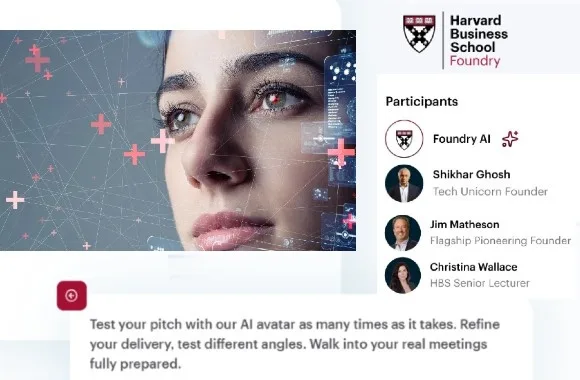
Images from a Harvard Business School AI bootcamp; Harvard Business School Foundry
OPINION: Universities should consider value of human interactions before welcoming AI humanoids to class
This fall, some universities are playing around with replacing student-teacher relationships with humanoid interactive technology – an experiment that should be done with caution given how deeply society, especially Gen Z, is struggling with loneliness and connection.
One example comes from Harvard Business School, which is offering a new bootcamp focused on using AI in business startups.
Alongside real professors, the bootcamp uses AI “clones” of the professors that help students practice “investor pitches, sales calls, and board meetings,” Fortunereported earlier this week.
Participants “can even test their pitches with an AI avatar repeatedly before a real meeting,” the report states.
The avatars also “help with startup questions using Harvard Business School-inspired tools-in-2026-grouped-by-what-they-replace/” title=”10 AI SEO tools in 2026, grouped by what they replace”>tools and guidance,” according to a FAQ page about the program.
“Our AI Advisor clones are inspired by the teaching style or areas of expertise of real professors, but they’re not intended to be exact replicas,” the webpage states.
Fortune described the AI humanoids in more detail:
The “clones” include seven HBS professors and senior lecturers with backgrounds spanning venture capital, business-model design, board dynamics and startup strategy. Their participation was voluntary, with the program having dedicated interviews and recording sessions, testing and ongoing faculty feedback as part of the process.
“The goal isn’t to create a substitute for me,” Shikhar Ghosh, one of the cloned HBS professors , told Fortune. “It’s to give founders another way to prepare and challenge their thinking, so that when we do come together live, we can spend more of that valuable time on the questions where human judgment and conversation matter most.”
The bootcamp, which costs $699, is not specifically for college students and it’s not for academic credit. Instead, it’s an independent education program open to anyone interested in learning that skill set.
Cost savings and accessibility to a wider audience are among the motives for using AI avatars, Georgia Tech Professor David Joyner told Fortune.
Joyner also has used an avatar of himself in his classrooms, “modeled on [his] appearance and voice … as part of a broader effort to democratize online learning.”
Another university embracing the technology is Embry-Riddle Aeronautical University where, this fall, students will interact with AI avatars in a space tourism class.
Meanwhile, the taxpayer-funded National Science Foundation currently is supporting experiments with AI avatars at five universities, The College Fixreported last week.
But some scholars are rightly concerned about the impact of substituting AI avatars, even if only in part, for human teachers.
Speaking with Fortune, Stanford University lecturer Kian Katanforoosh said that “AI ‘can replicate many of the things professors do repeatedly’ like answering unlimited questions and explaining concepts in different ways, but can’t truly know a student or be there for them.”
“What AI cannot fully replicate is knowing a student as a person,” Katanforoosh said. “AI can simulate some of these behaviors, but today it cannot put its own reputation at stake or genuinely care what happens next.”
As the Stanford scholar suggested, a professor’s value rests in more than just how well they teach a subject. It’s also their ability to be a role model by demonstrating respectful dialogue, to encourage a student who has potential but is struggling, or to modify how to teach a concept on the spot based on their knowledge of the traits of a specific class of students.
Professors also have the unique ability to teach through failure, too, whether it’s their own or others’. Even havinga bad professor can be a good lesson for students. But all this comes through personal interaction, from the deep discussions to the mundane.
American society already has a loneliness problem. A technology problem. Relationship problems. And academia’s main demographic, Gen Z, is the generation of COVID lockdowns, of smartphones, of social media influencers, of short attention spans.
All this should have universities thinking twice before jumping head-first into replacing, even just for part of a class, their professors with technology.
MORE: Professors experiment with using AI humanoids to teach students
