

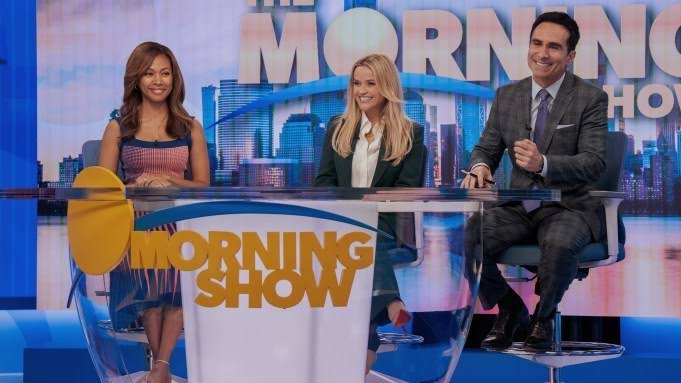
When The Morning Show Season 4 premiered in September 2025 with a plot built around a deepfake video that destroys a news anchor’s credibility and a network that deploys a synthetic, multilingual AI version of its star anchor to cover the Olympics, critics called it timely soap opera dressed up in tech anxiety. They were right about the soap opera. They substantially underestimated the science.
Season 5 is currently in production, with Apple TV+ having confirmed in July 2026 that it will be the show’s final season this year. As that new chapter begins shooting, the technological picture Season 4 painted looks considerably more accurate than its initial reception suggested — and the gap between what generative AI can fabricate and what institutional systems can authenticate has grown since the season’s November 2025 finale.
What Season 4 Was Actually Depicting
The fourth season’s primary technical architecture rested on two converging systems. In the first plotline, a deepfake video surfaced purporting to show anchor Alex Levy (Jennifer Aniston) orchestrating the defection of an Iranian fencer’s father — a nuclear scientist — in a way that would implicate the UBN network in a geopolitical incident and potentially cost it its Olympic broadcast rights. The show’s crucial narrative detail was the nature of the fabrication: it was not dramatic or spectacular but deliberately ordinary. A plausible private moment. The kind of footage that audiences are predisposed to treat as authentic precisely because it lacked the hallmarks of staged content. Executive producer Mimi Leder confirmed trust is the season’s central theme, noting that deepfakes make it very hard to know what is real.
In the second plotline, network CEO Stella Bak (Greta Lee) purchased an AI system capable of replicating Alex’s voice and face in dozens of languages, so the network could broadcast a synthetic Alex to global Olympic audiences without the real anchor physically presenting in each locale. Stella’s project collapsed in a publicly humiliating AI failure in Episode 6, “If Then,” which aired October 22, 2025 — a collapse ending Stella’s tenure.
These two plotlines represent distinct classes of real deployed technology, and Season 4 was more technically honest about both of them than critics acknowledged.
How Deepfake Architecture Actually Works — and Why the Shift to Diffusion Models Matters
The term “deepfake” fuses “deep learning” and “fake.” The underlying architecture has evolved substantially since the technology entered mainstream awareness after 2017, and that evolution has a direct forensic consequence that the show’s plot implicitly depends on.
The foundational architecture is the Generative Adversarial Network, or GAN — a dual-network system introduced by Ian Goodfellow in 2014 in which a generator network learns to produce synthetic images while a discriminator network learns to classify them as real or fake. The two networks train in adversarial tension: every improvement to the discriminator forces the generator to produce higher-quality forgeries, producing outputs that progressively approach photorealism. In practice, a face-swap GAN does not paste one face onto another. An autoencoder compresses the target subject’s facial representation into a high-dimensional mathematical abstraction, and a decoder reconstructs those features onto the source footage’s geometric structure, guided by a facial landmark detection system tracking approximately 68 to 468 points on a face — eye corners, lip margins, jawline contours. The result is a neural network synthesizing a plausible face at every frame, not a photograph manipulated in post-production.
Since approximately 2023, however, diffusion models have become the dominant architecture for high-fidelity synthetic media — the same underlying technology powering Stable Diffusion and contemporary text-to-video platforms. A diffusion model takes the inverse approach of a GAN: rather than generating in one forward pass, it learns to iteratively remove noise from a randomly initialized image, gradually resolving it into a coherent synthetic output. The denoising is guided by a transformer or U-Net architecture trained on the statistical regularities of real images.
This architectural shift has a critical forensic consequence. A deepfake detector trained on GAN artifacts — unnatural blinking, color boundary anomalies at the face’s edge, subtle temporal inconsistencies between frames — is effectively blind to diffusion-model outputs, which produce a different artifact signature entirely. The “moving goal post” problem documented in deepfake detection research is not a metaphor. It is the structural condition under which every generation of detector becomes partially obsolete when a new generation of generator arrives.
The numerical gap this produces is striking. The winning model achieved 65% accuracy in the Deepfake Detection Challenge — a competition hosted by Facebook involving 2,114 participants generating more than 35,000 models — on the holdout test set. An MIT research team published findings in December 2021 showing that ordinary humans are 69 to 72% accurate at identifying deepfakes in a random sample. Human detection is marginally better than the best algorithmic approach — a relationship that has not improved as generation quality has continued to advance.
Voice Cloning Has Crossed the Threshold the Show Described
Season 4’s second major AI plot — the synthetic multilingual Alex Levy broadcasting Olympic coverage — was dismissed by some critics as implausible corporate fantasy. The dismissal was incorrect.
Real-time neural voice conversion, also called voice cloning, uses a speaker embedding model to extract a speaker’s vocal characteristics — fundamental frequency contour, formant structure, breathiness, rhythm — and then conditions a text-to-speech neural network on those embeddings to generate arbitrary utterances in the target speaker’s voice. Face animation models driven by neural talking-head synthesis then synchronize lip movement, micro-expression, and head pose to the cloned audio. When Season 4 depicted a “global Alex Levy” speaking Mandarin to Chinese Olympic audiences, it was depicting a production pipeline that, as of 2025, required not months of development but weeks, and in some commercial offerings, hours.
Siwei Lyu, a computer scientist at the University at Buffalo who researches deepfakes and synthetic media, wrote in December 2025 that voice cloning indistinguishable threshold crossed. A few seconds of audio now suffice to generate a convincing clone complete with natural intonation, rhythm, emphasis, emotion, pauses, and breathing noise.
The rate of voice-based deepfake attacks increased more than 1,300% between 2023 and 2025, rising from roughly one documented incident per month to more than seven per day, according to the 2025 Voice Intelligence and Security Report from Pindrop. Commercially available tools including ElevenLabs and OpenAI’s Voice Engine can produce convincing voice clones from as few as three seconds of
The real-world parallel that Season 4’s Olympic anchor plotline most closely resembles is the 2020 South Korean AI anchor broadcast — an authorized deployment that illustrated both the technical feasibility and the public perception challenge: audiences and regulators cannot reliably distinguish a synthetic anchor from a real one in a live broadcast context, and no consumer-grade tool yet exists to let an ordinary viewer make that determination.
The Liar’s Dividend: What Critics Missed Entirely
Season 4 dramatized the attack side of the deepfake epistemological problem: a synthetic video passes as real and destroys an innocent person’s credibility. What the critical conversation largely missed — and what the show only partially gestured toward — is the inverse problem that researchers call the “liar’s dividend.”
When synthetic media can convincingly impersonate real people, a second exploit becomes available: real incriminating or embarrassing media can be dismissed as fabricated. A politician recorded saying something genuinely harmful can claim the video is a deepfake. A corporate executive captured in authentic audio discussing a cover-up can assert the recording was synthesized. The same technological capability that enables the attack Alex Levy suffered also provides cover for denying authentic evidence for anyone who needs to deny it.
The American Congressional Research Service warned formally that deepfakes enable espionage and liar’s dividend — deepfakes could be used to blackmail elected officials or those with access to classified information for espionage or influence purposes, and that the “liar’s dividend” means authentic blackmail materials could simultaneously be devalued, since a party possessing genuine incriminating footage can no longer rely on a jury’s inability to distinguish it from fabrication. The Morning Show depicted one side of this epistemological collapse. The full picture is symmetrical, and the second half is in many ways the more corrosive long-term problem for democratic institutions.
When the AI Turned Against Its Champion: Stella Bak’s Collapse as Institutional Allegory
The show’s most technically instructive plotline for a practitioner audience was not the deepfake of Alex Levy but the failure of the AI system Stella Bak built, bought, and staked her position on. In Episode 6, the system — pushed to deployment before it was finished, under pressure from Celine Dumont (Marion Cotillard) — produced outputs that exposed what the press described as a racist AI flameout, resulting in Stella’s forced exit from the CEO position she held.
The narrative beat is institutional rather than technical: a corporate executive championing a new AI system, a vendor relationship that prioritized speed over safety, a premature deployment under competitive pressure, and a public failure that the institutional sponsor absorbed rather than the system itself. These four elements — captured in eleven minutes of television — constitute a remarkably accurate pattern matching of how AI failures in institutional settings have played out in real-world cases from 2023 through 2026. The costs of AI system failures in production environments are routinely borne by the humans who deployed them, not by the systems that failed.
The AI Therapist Problem: Where the Show Was Right to be Anxious
Season 4’s third technological thread — characters using AI systems as informal therapists and emotional outlets — was the most forward-looking of the three, and the real-world data has since validated the anxiety.
A survey of more than 1,200 licensed psychologists conducted by the American Psychological Association in 2026 found that patients turning to AI chatbots — more than one-third reported patients using AI as what they described as an additional mental health professional. A study published in JAMA Pediatrics in 2026, based on a nationally representative survey conducted by RAND Corporation, found that nearly one in five U.S. youth had used AI chatbots for mental health advice — representing approximately 8.2 million young people between the ages of 12 and 21. Among those who did, 63% had not disclosed that use to anyone.
None of these tools are clinically validated. Unlike human therapists, large language models are not bound by ethical codes, mandated reporting laws, or professional training requirements. Research from Harvard Medical School published in June 2026 confirmed that one in six U.S. adults uses AI chatbots at least once a month for health information and advice.
The National Academy of Medicine panel convened on January 14, 2026 — titled “AI Chatbots For Mental Health: What Works, What Harms, and What’s Next” — directly addressed the regulatory gap. None of the major AI mental health tools had received clinical validation by the time of that panel.
What Season 4 captured in its AI-therapist subplot was not primarily a technology critique but an epistemological one: in both the AI therapist and the deepfaked anchor, the human subject is invited to trust a synthetic output as a proxy for a human relationship — the therapeutic relationship in one case, the journalistic relationship in the other. And in both cases, the synthetic origin is concealed, minimized, or normalized by institutional incentives. Claire Wardle, a misinformation researcher who developed the information disorder taxonomy First Draft now used in academic media studies, identified exactly this pattern — synthetic content exploiting pre-existing trust frameworks — as the category of disinformation most resistant to correction, because the trust relationship itself is the attack surface.
Recommendation Algorithms: The Distribution Layer Critics Barely Touched
The show’s fourth technological thread — podcaster-influencer Brodie (Boyd Holbrook) weaponizing engagement algorithms to spread conspiracy theories as content — received less critical attention than the deepfake plotline but addressed what researchers consider the harder structural problem. Deepfakes are a content problem; recommendation algorithms are a distribution problem.
Recommendation systems optimize for engagement — a proxy metric that correlates strongly with emotional arousal, identity affirmation, and outrage. A well-researched, nuanced news segment competes for attention against a conspiracy-inflected, emotionally charged podcast clip, and the algorithmic infrastructure of every major platform is structurally biased toward the latter. The show correctly portrayed Brodie as aware of this dynamic and strategically exploiting it. What it left partially unanswered — and what platform research since 2019 has only partially resolved — is whether algorithmic radicalization is primarily a product of bad actors exploiting neutral systems or neutral actors rationally responding to systems that are structurally bad. The empirical consensus from platform research is that both are simultaneously true, and that the structural problem is harder to address by regulating individual actors.
The Provenance Gap Season 4 Depicted — and Where It Stands Now
The deepest accuracy in Season 4 was not in any specific technical detail but in its worldbuilding premise: a world in which institutional verification mechanisms had not kept pace with generative AI’s fabrication capabilities. This is a factually accurate description of the world as of 2025 and remains accurate in September 2026.
The Coalition for Content Provenance Authenticity, known as C2PA, is the open standard the technology industry converged on to address this through cryptographic provenance. Founded in 2021 by Adobe, Arm, the BBC, Intel, and Microsoft, the coalition had grown to more than 6,000 member organizations as of January 2026. C2PA v2.2, published in May 2025, added video and streaming support. Camera manufacturers including Sony, Canon, Nikon, Leica, and Samsung now sign images at the moment of capture with hardware-rooted cryptographic keys. EU AI Act Article 50 enforcement, which began in August 2026, required mandatory machine-readable disclosure on AI-generated content in European markets. California SB 942 took effect January 2026.
The fundamental limitation of this infrastructure is structural rather than technical: C2PA certifies the history of content, not its truth, and it works only for content that originates from a C2PA-enabled device or workflow. The vast majority of content lacks provenance metadata. Everything created before C2PA adoption, everything recorded on non-compliant devices, and everything that has had its metadata stripped during distribution is invisible to the system. The Season 4 worldbuilding assumed — accurately — that provenance infrastructure would exist in incomplete and fragmentary form rather than as a universal consumer-facing protection.
The show’s fictional universe required a world in which Alex Levy’s authentic presence was a precondition of the newsroom’s epistemic authority, and in which a synthetic version of her could dissolve that authority precisely because no viewer-facing authentication mechanism existed. That is a description of September 2026, not a fictional extrapolation.
Why The Morning Show’s Newsroom Setting Was the Right Laboratory
The franchise has, since its 2019 debut, used the fictional newsroom as a controlled environment in which epistemological crises can be examined at the level of individual human consequence. Season 1 used the #MeToo reckoning; Season 3 used COVID-19 and the January 6 insurrection; Season 4 used deepfakes and AI.
This formula works because the newsroom is the only institutional setting in which the question “what is true and who do we trust to tell us?” functions simultaneously as a professional obligation and a personal crisis. Alex Levy’s deepfake was not just a threat to her employment. It was a professional negation — a synthetic version of herself undermining the single social function her career was built on. The show’s format compressed the epistemological problem to its most consequential form: not “can I trust this random video?” but “can I trust the person I have trusted for decades to tell me what is real?”
Deepfake incidents tracked globally surged from approximately 500,000 in 2023 to over 8 million in 2025, a 900% increase in two years, according to cybersecurity firm DeepStrike. Global financial losses from deepfake fraud have been estimated at $12 billion, with projections suggesting the figure could reach $40 billion within three years.
Season 5 begins production with a new cast that includes Jeff Daniels, Renee Rapp, Jesse Williams, Sean Hayes, and Lizzy Caplan joining the returning ensemble. The show is heading into its final chapter having established, in Season 4, a framework for understanding the deepfake problem that is more technically grounded and more sociologically complete than it was given credit for. The gap between what generative AI can produce and what institutional systems can authenticate is not closing on any timeline that matters for the next few years of democratic communication. That gap is the show’s real subject, and it was right about it.
Frequently Asked Questions
How do deepfakes actually work at an architectural level — and why is the GAN-to-diffusion shift important for detection?
Deepfakes began with Generative Adversarial Networks, in which a generator and discriminator network train in adversarial competition until the generator produces outputs the discriminator cannot reliably classify as fake. A decoder then reconstructs target facial features onto source footage, guided by facial landmark tracking. Since approximately 2023, diffusion models — which iteratively denoise a randomly initialized image rather than generating in one forward pass — have become the dominant architecture for high-fidelity synthetic media. The forensic consequence is significant: any detector trained specifically to identify GAN artifacts (unnatural blinking, edge anomalies, temporal flickering) produces different results against diffusion-model outputs, which generate a different artifact signature entirely. Every generation of detection tools is at least partially obsoleted by a new generation of generative architecture. The Deepfake Detection Challenge’s winning model achieved 65% accuracy on its holdout test set — a figure that has not meaningfully improved even as generation quality has increased.
Is voice cloning as easy and convincing as The Morning Show Season 4 suggested?
Yes, and the capability has advanced substantially since Season 4 aired. Commercially available tools including ElevenLabs and OpenAI’s Voice Engine can produce convincing voice clones from as few as three seconds of source audio, complete with the target speaker’s intonation, rhythm, emphasis, pauses, and breathing characteristics. Siwei Lyu, a deepfake researcher at the University at Buffalo, wrote in December 2025 that voice cloning indistinguishable threshold crossed — the point at which perceptual tells that once revealed synthetic voices have largely disappeared. The rate of voice-based deepfake attacks increased more than 1,300% between 2023 and 2025.
What is the “liar’s dividend” and why does it make the deepfake problem worse than the Season 4 plot suggested?
The “liar’s dividend” is the inverse of the problem Season 4 dramatized. When synthetic media can convincingly pass as real, a second exploit becomes available: real, authentic, incriminating media can be dismissed as fabricated. A politician or executive captured on genuine audio or video making damaging statements can credibly claim the footage was AI-generated. The same technology that allowed a synthetic Alex Levy to be fabricated also means that genuine footage of anyone can be contested. This doubles the epistemological damage: deepfakes do not only allow false things to seem true; they also allow true things to be denied as false. The Congressional Research Service identified this dynamic as a specific national security risk, noting that authentic incriminating footage loses credibility value when juries and audiences cannot reliably distinguish it from fabrication.
Does C2PA solve the deepfake provenance problem Season 4 described?
Not completely, and not yet at consumer scale. C2PA is a cryptographic standard, maintained by a coalition that includes Adobe, the BBC, Intel, and Microsoft, that embeds a signed manifest inside a media file recording its origin device, processing history, and any AI involvement. The coalition had grown to 6,000 member organizations by January 2026, and EU AI Act Article 50 enforcement, which began in August 2026, now requires machine-readable disclosure on AI-generated content in European markets. The fundamental limitation is that C2PA works only for content originating from C2PA-enabled devices — the vast majority of digital content already in circulation carries no provenance metadata at all. C2PA certifies a chain of custody for compliant content; it does not authenticate content that entered circulation before the standard was adopted or from non-compliant devices. The provenance gap Season 4 depicted is real, and it will take years of hardware adoption to close.
ⓒ 2026 TECHTIMES.com All rights reserved. Do not reproduce without permission.
