

Hama.com
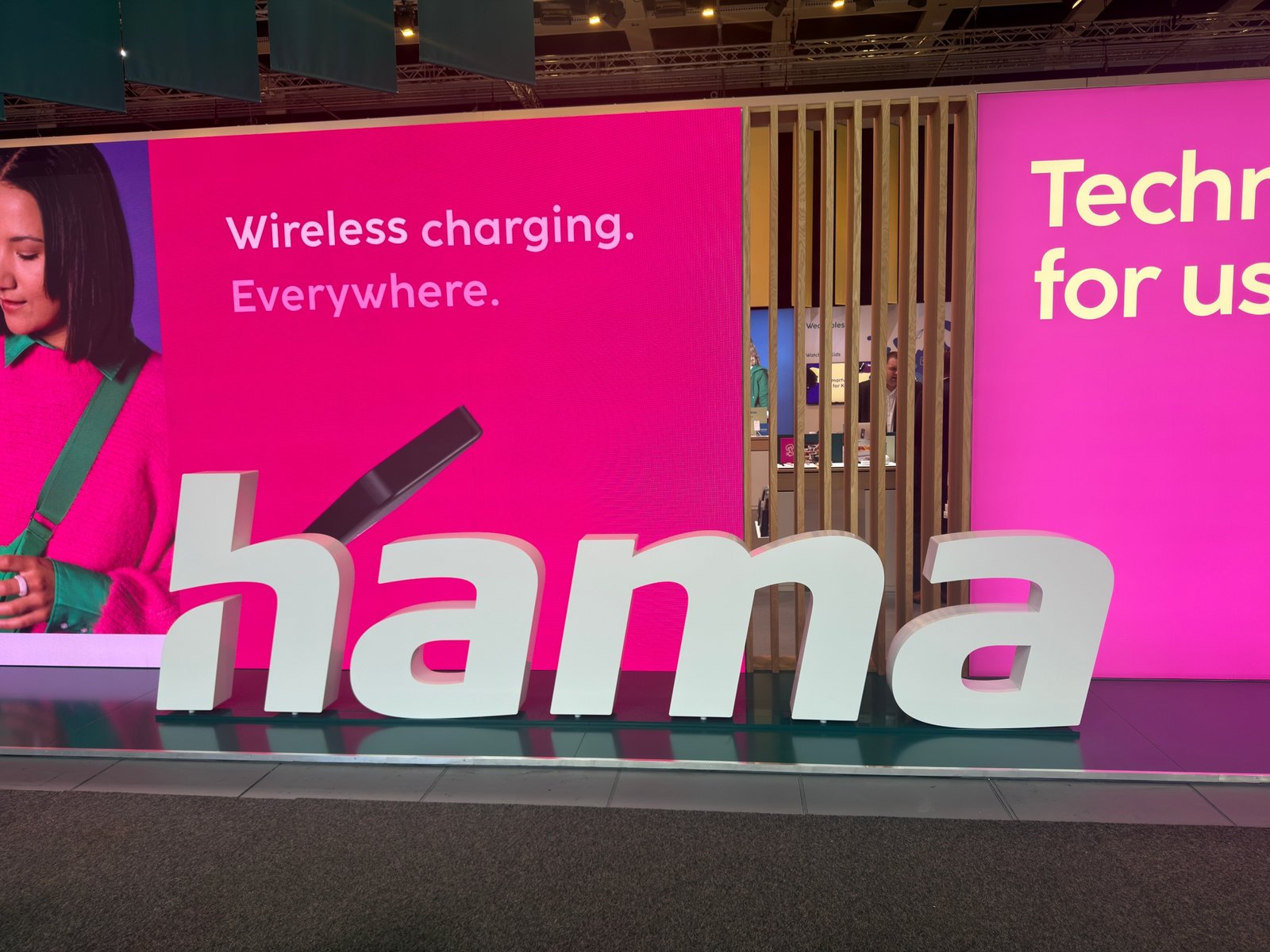
IFA Berlin 2026 opened today at Messe Berlin, and the company making your phone case and HDMI cables arrived with something no accessories manufacturer has brought to Europe’s largest consumer electronics show before: a coherent claim to the connected-life market. Hama GmbH & Co KG — the 103-year-old German accessories giant headquartered in Monheim, Bavaria — is exhibiting at Hall 4.2, Stand H4.2-147, presenting the most diversified product lineup it has ever shown at a single trade event, spanning a health-tracking smart ring, AI-powered headphones, portable charging hardware with a built-in rotating screen, USB-C rechargeable batteries, a children’s safety smartwatch, and an outdoor navigation watch.
The moment matters beyond the product list. When a company with an established European retail network in 19 countries — whose 2,500 employees have spent a century selling phone cases, cables, and speakers — starts stacking smart rings, AI audio, and a 1.1-million-user smart home platform into a single trade-show narrative, it signals something specific about where the smart wearable market has arrived: the point at which the technology costs have fallen far enough for mainstream accessories brands to enter credibly, built on top of third-party platforms (Bragi’s AI audio platform and the Matter connectivity standard) rather than proprietary development. The Bluetooth speaker market reached this inflection in 2012–2015; the smart ring market appears to have arrived there now.
Hama’s IFA theme — “Connect — Vernetzt, damit dein Leben einfacher wird” (“Connected, so your life becomes easier”) — is more than a slogan. It is a direct answer to a documented tension in the smart device market. “People want more guidance when it comes to technology. Connected products must make life easier, not more complex,” said Bastian Strommer, Hama’s Senior Head of Product Portfolio Management for Consumer Electronics, in Hama’s IFA press materials. The numbers behind that premise are concrete: 1.8 million devices have been set up in the Hama Smart Home ecosystem (Hama-reported figures, not independently audited), with approximately one million in regular use and more than 1.1 million registered users. Around 30,000 new devices join the platform monthly, rising to 50,000 during winter months.
Ring One Steps Into IFA as Its First Major Trade-Show Appearance
The Ring One smart ring — the booth’s centerpiece and one of IFA 2026’s designated product highlights — made its first major trade-show appearance today, more than a month after Hama announced it on August 4. The ring is priced at €129 with no subscription fee attached to any feature, ever.
The ring is stainless steel — a material choice that directly explains the price. Titanium, used by the Oura Ring 5 and Samsung Galaxy Ring, is approximately 43 percent lighter than stainless steel at equivalent volume (density: steel ~7.9 g/cm³ vs. titanium ~4.5 g/cm³). Stainless steel is a cost-effective substitute that enables the €129 price point; what it costs the wearer is weight. Comparable stainless steel smart rings typically fall in the 4–8 gram range, meaningfully heavier than the Oura Ring 5’s 2.0–2.69 grams. For a ring worn 24 hours a day including overnight sleep tracking, that difference is not cosmetic. A Biomimetics 2025 smart ring review covering 107 clinical studies and approximately 100,000 participants found that wear rates drop from approximately 80 percent at three months to 43 percent at twelve months, with nighttime comfort consistently cited as the primary driver.
The sensor stack does what the category now requires: continuous heart rate monitoring, heart rate variability (HRV), blood oxygen saturation (SpO2) via photoplethysmography (PPG), body temperature, and sleep staging that breaks rest into light, deep, REM, and wake phases. PPG works by shining LED light — typically a combination of green, red, and infrared wavelengths — through the finger tissue and measuring reflected light variation as blood pulses through the capillaries. The finger provides a physiological advantage over the wrist: denser capillary distribution, thinner overlying skin, and blood vessels positioned closer to the surface produce a cleaner signal. The same finger PPG accuracy study found that finger-based PPG achieves a heart rate correlation of r² = 0.996 against ECG gold standard for resting measurements. One technical note worth understanding: what smart rings report as “HRV” is technically pulse rate variability (PRV), measured optically rather than from the electrical R-to-R interval that clinical ECG captures. The two correlate closely during rest and sleep — the Ring One’s primary monitoring window — but the distinction matters in clinical contexts.
A recent engineering challenge in smart ring design is worth flagging here: ring rotation on the finger alters the optical path between LED and photodetector, affecting signal accuracy. A rotation-robust PPG ring study from the journal Sensors tested a rotation-robust sensor design and found that a ±60-degree LED-to-photodetector angle achieves optimal light penetration into the finger’s microcirculation layer, with heart rate mean absolute error of 0.78–0.82 beats per minute across wavelengths. Hama has not disclosed the Ring One’s specific sensor geometry, so rotation robustness remains unverified by independent testing. The Ring One has no third-party clinical accuracy validation published yet.
The ring supports 120 sports, includes a menstrual cycle reminder, delivers vibration-based smartphone notifications without a screen, and carries a 5 ATM water resistance rating suitable for swimming. Battery life is rated at three to four days — modest compared to the Oura Ring 5’s six-to-nine days and Ultrahuman Ring Pro’s 15-day rating, requiring charging roughly twice per week. The ring charges via an included case and is available in US ring sizes 7 through 12, in silver and black. All data syncs to the Hama Active app at no cost.
Passion Clarity AI: The Headphone That Won a Major Audio Award Before Shipping
Hama’s AI audio story has a notable pedigree. The Passion Clarity AI headphone — developed in collaboration with Bragi GmbH, a Munich-based AI audio software company that helped pioneer true wireless earphones in 2015 — won the IFA Innovation Award “Best in Audio” before the product had reached consumers. An international jury of tech journalists and industry experts selected it. The headphone (item number 00221819) is expected to ship at some point in 2026; a specific delivery date has not been confirmed.
The Bragi Sound App that powers the Passion Clarity AI is not a standard equalizer. Bragi, which shifted from hardware to an AI audio software platform after 2017 and has since partnered with Bose for noise-cancellation technology and with OpenAI for a ChatGPT voice integration via the Bragi OpenAI partnership July 2025, uses machine learning to build an individualized frequency-response profile that adapts over time to a listener’s actual usage patterns — not a one-time hearing test. The app then adjusts equalization in real time using digital signal processing embedded in the headphone chip. Three additional layers sit on top: active noise cancellation, a live translation feature using a cloud-based speech-to-text, translation, and text-to-speech pipeline, and an integrated Chat AI powered by the OpenAI integration that lets users query it by voice without opening a smartphone app.
For consumers who have seen “AI headphone” used as marketing language with nothing behind it, the Bragi platform’s technology track record — including a Bragi and CEVA collaboration for ultra-low-power embedded inference — is a meaningful differentiator. Hama is the consumer brand; Bragi is the technology engine underneath.
Power Pack “Fold”: A Power Bank That Doesn’t Need an Adapter
The Power Pack “Fold” addresses a specific problem that anyone who has traveled internationally, worked from a café, or arrived at an airport with a dead laptop knows: power banks need to be separately charged, usually with a cable, and if you forget the cable you’re stuck. Hama’s solution is mechanical: a 230V EU mains plug folds directly into the unit’s housing, and a charging cable is permanently integrated, so the pack plugs directly into a wall socket and becomes its own charger. No cable to forget. No adapter to track.
Both models carry 10,000 mAh of capacity. The design distinction between them is output wattage: the 30W model (article 201786, €54.99) delivers enough to charge most smartphones and tablets at full speed via USB-C Power Delivery; the 65W model (article 201787, €69.99) clears the threshold needed for most modern laptops, including all MacBook configurations, which range from 30W to 140W depending on model. The USB Power Delivery standard, maintained by USB-IF, defines the power negotiation protocol that enables these charging speeds.
The feature that elevates both models above standard power banks is the built-in TFT display, which rotates 180 degrees — meaning the readout is legible regardless of how the pack is oriented on a desk, in a bag opening, or plugged into a wall. The display shows output wattage per port, remaining battery percentage, temperature, and accumulated charge cycles in real time — transparency that consumer power banks almost never provide. Most power bank LEDs show four dots. Seeing live wattage and temperature tells a user whether their device is actually fast-charging or throttling, and whether the pack itself is running hot. Full specifications were announced via Hama’s Power Pack Fold announcement.
Rechargeable AA/AAA Batteries With USB-C Charging Box
Rounding out the energy lineup, Hama is introducing lithium-ion rechargeable AA and AAA batteries with a dedicated charging box that accepts up to eight cells simultaneously via a single USB-C connection. The box includes protection circuitry designed to detect faulty cells before damage occurs. The Hama rechargeable battery box announcement confirmed both the AA and AAA sets carry a recommended retail price of €39.99. For households with a mix of remote controls, game controllers, and devices that still run on standard alkaline cells, a single USB-C cable that charges eight batteries at once eliminates a minor but persistent friction of modern home management.
Children’s Smartwatch and Vertex Outdoor Watch Address Distinct Safety Needs
Two new smartwatches in the Hama IFA lineup serve related but separate markets.
The children’s smartwatch targets the specific challenge of giving a child more independence without losing parental contact. The device supports two-way video and voice calls, delivers live location data, and includes safety functions — all without requiring the child to own a smartphone. The gap this fills is a well-documented parental anxiety: children who are old enough to walk to school or spend time at a friend’s house unsupervised, but who parents are not ready to give an unrestricted smartphone. A dedicated children’s watch with calling and location functions, with no app store or browser, addresses that window directly. Full details were confirmed in Hama’s children’s smartwatch announcement.
The Vertex outdoor smartwatch targets a different use case: adults who need navigation support in the field but find the continuous notifications of a full smartwatch distracting during outdoor activities. The Vertex includes offline maps for use without cellular connectivity, turn-by-turn navigation, and an extended battery life. Specifics on battery duration and map coverage have not yet been confirmed by independent sources; Hama is expected to provide full technical specifications during the IFA show period, as noted in Hama’s Vertex outdoor watch announcement.
Smart Home: Matter Adoption and Platform Scale
Hama’s Smart Home platform is already operating at a scale that most European accessories brands have not reached. Three out of four of its Smart Home products now support Matter 1.x, the Connectivity Standards Alliance’s cross-manufacturer protocol that allows devices from different brands to work within Apple Home, Google Home, Amazon Alexa, and Samsung SmartThings simultaneously without requiring brand-specific hubs. Matter 1.6, released June 17, 2026, added NFC-based commissioning and the Joint Fabric feature for shared multi-ecosystem device networks — the latter directly relevant to households that mix Hama devices with products from other manufacturers.
One important reality check on the Matter promise: as of mid-2026, platform implementation still lags the specification. According to a Matter adoption status 2026 analysis, Google Home has not fully implemented some Matter 1.2 categories, and the gap between a device being certified for Matter and that certification translating to seamless operation across all ecosystems can run months to a year. Hama’s 75% Matter adoption rate across its product line (Hama-reported) is a meaningful commitment; what it guarantees depends on which platform a buyer is using.
The platform’s monthly 30,000 new device additions — rising to 50,000 during the winter buying season — suggest organic growth rather than a stalled product line. More than 235,000 users manage two Hama Smart Home devices, and more than 150,000 manage three or more (all figures Hama-reported). The Hama Home App is the management interface across the ecosystem.
What This Means for Readers Considering Any of These Products
The IFA 2026 showing gives European consumers something the August Ring One announcement did not: a physical opportunity to handle, try, and compare these products in a show environment before committing to any of them. For buyers deciding between the Ring One and competitors, the weight difference is the central tradeoff to understand firsthand — no reviewer can tell you in advance how a stainless steel ring will feel on your specific finger during a night’s sleep.
For the AI headphones, the relevant question is when the Passion Clarity AI will actually ship. The 2025 IFA Innovation Award was awarded to a product that had not yet reached consumers; as of September 4, 2026, Hama has confirmed the headphone will arrive “in the course of 2026” but has not provided a specific date. Visitors to Hall 4.2 at IFA this week are among the first consumers to encounter it in a live-demo environment.
The Power Pack “Fold” is the lineup’s most immediately practical product — both models solve a real problem (separate charger plus power bank consolidation) at prices that are competitive for what they include. Travelers who routinely carry a phone charger and a power bank as two separate items have a straightforward case for switching to either model.
IFA Berlin 2026 runs through September 8 at Messe Berlin. Hama is at Hall 4.2, Stand H4.2-147.
All currency conversions in this article are approximate, based on exchange rates as of September 4, 2026, and subject to change.
Frequently Asked Questions
Does the Hama Ring One require a subscription?
No. All data collected by the Ring One syncs to the Hama Active app without any subscription fee or additional cost for any feature, including HRV tracking, sleep staging, SpO2 monitoring, and sports tracking across 120 disciplines. This is a deliberate positioning decision in a smart ring market where Oura — the category leader — charges $5.99 per month or $69.99 per year to unlock its full analytics suite. Samsung Galaxy Ring, RingConn, and Ultrahuman Ring Pro all offer no-subscription models; Hama’s Ring One joins that group at the lower end of the price range.
What is the Bragi Sound App, and how does AI adaptive audio actually work?
Bragi GmbH is a Munich-based audio technology company that helped pioneer true wireless earphones in 2015 and has since pivoted to licensing its AI audio software platform to consumer electronics brands. The Bragi Sound App uses machine learning to build an individualized frequency-response profile from a listener’s actual usage history — it does not run a one-time hearing test but adapts continuously over time. A digital signal processor embedded in the headphone chip then adjusts equalization in real time based on that profile. The app adds live translation (a cloud speech-to-text, translation, and text-to-speech pipeline) and a ChatGPT-powered voice assistant (via Bragi’s July 2025 OpenAI partnership) that operates without requiring the user to have a phone app open. The Passion Clarity AI headphone is the first Hama product to integrate this platform.
How does the Hama Smart Home ecosystem relate to Apple Home, Google Home, and Alexa?
Three out of four Hama Smart Home products now carry Matter certification — the cross-manufacturer protocol developed by the Connectivity Standards Alliance and backed by Apple, Google, Amazon, and Samsung. Matter-certified devices can be added to and controlled from multiple competing ecosystems simultaneously, without brand-specific hubs. Hama’s platform claims 1.8 million devices set up and 1.1 million registered users (Hama-reported figures). As with all Matter-certified products, actual interoperability depends on whether your specific ecosystem has implemented the Matter version that covers your device category — Google Home in particular has lagged behind the specification as of mid-2026.
What specifically does the Power Pack “Fold’s” rotating TFT display show that a standard power bank doesn’t?
Standard power bank status indicators use a row of four LED dots — each dot represents 25 percent of remaining charge, with no more precision than that. The Power Pack “Fold’s” TFT display shows remaining battery percentage in real time, live output wattage per USB-C port (so you can confirm whether fast-charging is actually happening or whether the device is throttling), ambient temperature of the pack (an important safety signal if the battery is running hot), and cumulative charge cycle count (relevant for long-term battery health monitoring). The display is 180-degree rotating, meaning it is legible regardless of whether the unit is sitting on a desk, plugged into a wall, or positioned inside a bag — a small but practical design detail that fixed displays cannot provide.
ⓒ 2026 TECHTIMES.com All rights reserved. Do not reproduce without permission.
