

Add preferred source1
Genspark officially released Media Studio, a video agent workbench, on Oct. 29, integrating more than 70 model versions from over 20 vendors, with a large language model acting as the “director” that orchestrates the full pipeline of script, storyboard, visuals, score and subtitles. The product’s headline feature is “Story Bible,” which saves character settings and reuses them across subsequent shots, and it supports partial reshoots and frame editing; knowledge-explainer videos use a code-rendering approach to reduce credit consumption. A 50% member credit discount runs alongside the launch. The product reflects how the AI content-generation race is shifting from single-model capability competition toward multi-model orchestration and workflow integration, further lowering the barrier to lightweight video production, though visual consistency and audio-visual synchronization still need improvement.
Key Elements
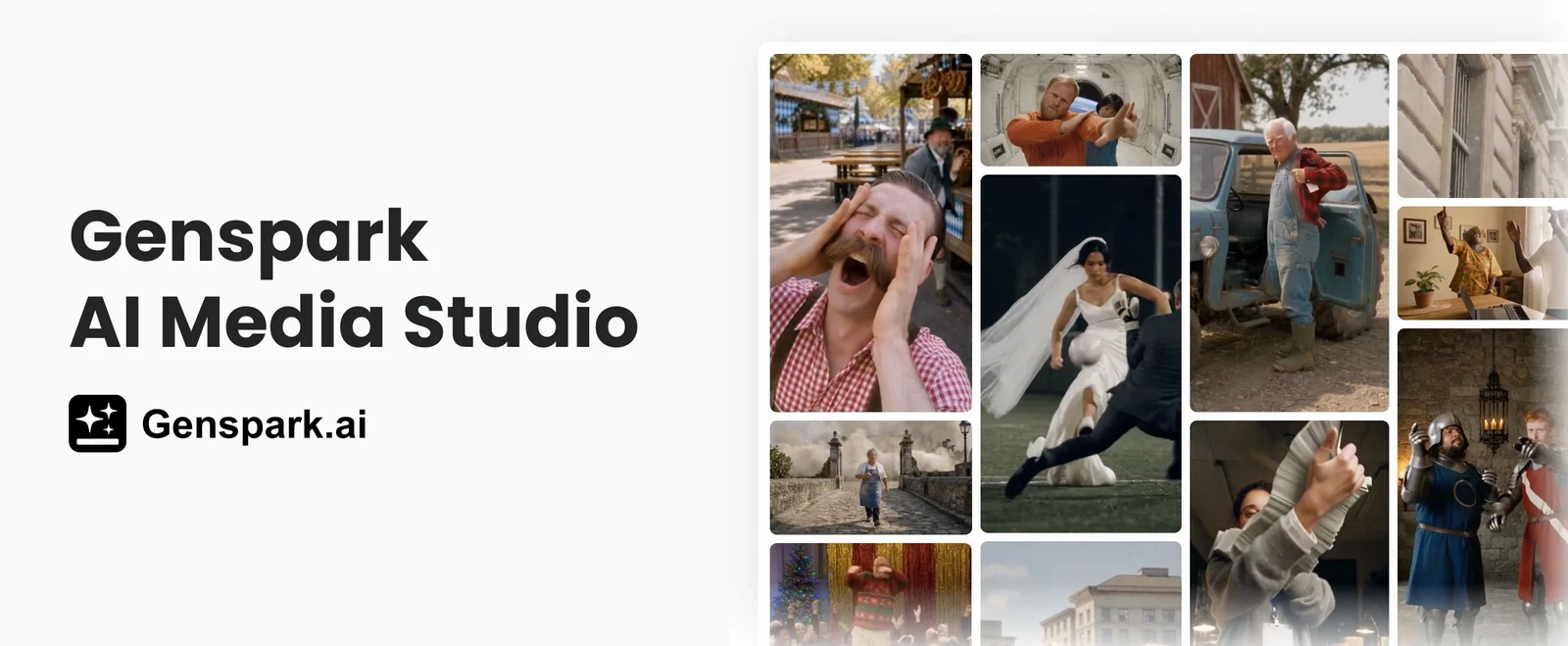
AI video creation tools are moving from “single-point generation” toward “full-pipeline collaboration.” On Oct. 29 (6 a.m. EDT on Oct. 27), Genspark officially launched Media Studio, a video agent workbench that integrates more than 70 model versions from over 20 vendors onto a single canvas. Users need only describe their requirements in natural language to complete the entire production process—from script and storyboard to visual generation, score and subtitles.
According to Genspark’s official introduction, Media Studio’s core idea is to let a large language model serve as the “director brain,” responsible for understanding requirements, writing scripts and dispatching different models to divide the work. Currently available director models come in three tiers: DeepSeek V4.1 Flash, Claude Opus 5.5 and Claude Fable 5.1. In the execution stage, Seedance 2.5, Kling and Veo handle video generation, GPT Image and Nano Banana handle images, and audio models such as ElevenLabs handle sound.
To coincide with the launch, Genspark rolled out a limited-time promotion: from 6 p.m. Beijing time on Oct. 27 to 6 p.m. on Nov. 4, Plus and Pro members get 50% off credit consumption within Media Studio, covering planning, image, video, audio and 3D generation.
From “Story Bible” to Final Cut: Breaking Down the Short-Drama Production Pipeline
Media Studio’s most closely watched feature is the “Story Bible.” It allows users to create a project around a theme, with the agent automatically generating character settings, costumes, props and character reference photos, and saving these settings as reusable fixed assets. Subsequent shots are generated according to the unified settings, avoiding inconsistencies in a character’s appearance from one shot to the next.
Take a test project titled “The Two Brothers of the U.S. IPO” as an example. The agent generated a corporate-battle script around the theme, in which the older brother is a managing director at a lead underwriting investment bank and the younger brother is the founder of a company preparing to list. It then produced detailed character settings and reference photos, with as many as 35 items requiring item-by-item user approval. After the settings were confirmed, the system split the original five scenes into 84 shots, then combined them into 12 video units; after prompts were written, it called Seedance 2.5 to generate video clips.
During generation, the agent checks results against the script and settings, proactively reworks scenes with continuity errors or inconsistencies with the settings, and prompts users to re-run drafts. Once all drafts are complete, the process moves to editing, scoring and subtitles. The test final cut automatically included bilingual Chinese-English subtitles, but the latter half had issues such as audio-visual desynchronization and some frame skipping.
Official information shows that Media Studio organizes the production process into different skills—one set of methods for shooting commercials and another for shooting narrative short films—and the agent selects based on task type. For revision needs, the product offers a “Reshoot clips” feature: users can box out unsatisfactory segments on the timeline, specifying up to five segments at a time, each at least four seconds long, and the system regenerates them while preserving the original footage’s motion and camera position. If only a certain object in the frame is distracting, users can use “Frame edit” to box, select, replace or remove it, applicable to videos of 30 seconds or less.
Knowledge-Explainer Videos Take the Code-Rendering Route, Cost Structure Diverges
It is worth noting that although both are called video, knowledge-explainer videos and narrative short films do not follow the same technical route. Knowledge Explainer mainly adopts a code-to-video approach, in which AI writes code to lay out text, charts and animations and then renders them into video, rather than handing every second of footage to a video model for generation. According to official explanations, code rendering itself does not consume credits, while narration and a small number of atmospheric shots are billed separately.
Narrative short films rely more on advance control of character motion and camera work. To this end, Media Studio offers a 3D white-model preview feature: before formal generation, scenes are built with white models to determine character positioning and camera angles. This step does not call video models; once confirmed, Seedance produces the footage. The product generates 480p drafts by default, and users can upgrade to 1080p after they are satisfied, reducing rework costs for high-definition final cuts.
For professional creation, Media Studio offers a layer editor and multi-track video timeline, and supports exporting PSD files, Premiere projects or CapCut drafts for further refinement.
Competition in AI Creation Tools Shifts Toward Workflow Integration
Genspark’s launch reflects a clear trend in the AI content-generation sector: the focus of competition is shifting from the generation quality of a single model to multi-model orchestration and workflow integration capabilities. Over the past year, video-generation models have iterated rapidly on image quality and duration, but users still need to switch between multiple platforms and manually connect the script, image generation, voiceover and editing stages. Media Studio attempts to carry all intermediate products on a single canvas, letting the agent work continuously within the same context while users can step in and make changes at any time.
This approach aligns with the evolution direction of other AI collaboration platforms during the same period. An OpenAgents case reported by OSChina showed that a user, through about 15 rounds of one-sentence feedback each, had an agent complete a 161KB single-file 3D game in 17.75 hours, with all assets procedurally generated by code and actual AI output time of 5.9 hours. That case likewise emphasized workspace persistence, multi-agent access and process visibility—collaboration efficiency, rather than model capability, is becoming the key variable in competition at the tool layer.
For the content production industry, the maturation of such tools means the barrier to producing lightweight videos—short dramas, commercials, knowledge popularization and the like—is being lowered further. Work that in traditional workflows required collaboration among screenwriters, storyboard artists, cinematographers, editors and composers can now be partly chained together by agents, with the human role shifting to judging whether the story is compelling, whether the music fits and whether to keep a shot. However, hands-on testing also exposed the limitations of current technology: visual consistency, audio-visual synchronization and detail stability still need improvement, and final-cut quality still falls short of professional production.
For investors, Genspark’s model-aggregation approach means its revenue structure differs from that of single-model vendors—credit consumption is tied to membership subscriptions, while costs depend on the volume of calls to each vendor’s models. The limited-time 50% discount promotion, beyond customer acquisition, will also test users’ genuine willingness to stay with paid AI creation tools. Against the backdrop of increasingly homogenized model capabilities, whoever can make complex workflows simple enough is more likely to retain those “zero-foundation” creators.
